Autism Screening for Toddlers and Young Children: What Parents Need to Know
If you are searching for information about autism screening, you may have questions about your child’s development. First, take a deep breath. You are not alone.
Many parents begin exploring autism screening after noticing small differences in their child’s communication, behavior, or social development. Wondering simply means you are paying close attention to your child and being thoughtful about their growth, which is a loving and proactive first step.
Autism screening is a simple, evidence-based way to identify whether a young child may benefit from further evaluation for autism spectrum disorder (ASD). Gaining clarity early can open the door to helpful support, and early support can make a meaningful difference in a child’s development.
If your child is five years old or younger and you have developmental concerns, autism screening may be the next gentle and proactive step forward.

What Is Autism Screening?
Autism screening is a brief, evidence-based process used to identify young children who may be showing early signs of autism spectrum disorder. It helps determine whether a child may benefit from a full diagnostic evaluation.
Screening does not provide a diagnosis. Instead, it offers guidance about whether further assessment is recommended.
Research shows that autism spectrum disorder can sometimes be identified as early as 18 months of age. By age 2, a diagnosis made by an experienced professional is considered highly reliable. Even so, many children are not diagnosed until later, which can delay access to important early intervention services.
Choosing screening is a proactive and loving step. It is not about labeling your child. It is about gaining understanding and seeking support as early as possible so your child has every opportunity to grow and thrive
When Should You Consider Autism Screening?
You might consider autism screening if your child:
Has limited or no warm, joyful smiles or shared engagement
Does not consistently respond to their name
Has little or no babbling, gestures such as waving or pointing, or delayed speech
Shows limited interest in pretend play such as feeding a doll
Prefers to play alone instead of engaging in social games
Displays repetitive movements such as hand-flapping, rocking, spinning, or walking on tiptoes
Has strong reactions to sounds, textures, or lights
Struggles with back-and-forth interaction
Every child develops at their own pace. Some children simply take a little more time. However, when several of these signs appear together, screening for autism can provide helpful clarity.
Trust your instincts. You know your child best.
Recommended Autism Screening Timeline
The American Academy of Pediatrics recommends:
Developmental screening at 9 months
Developmental screening at 18 months
Developmental screening at 30 months
Specific autism screening at 18 months
Specific autism screening again at 24 months
Additional screening may be recommended for children at higher risk, including those born prematurely, those with low birth weight, or children who have a sibling with autism.
If concerns arise at any time, even outside of these milestone visits, you do not need to wait to ask about autism screening.
How Accurate Is an Autism Test?
Parents often ask, “Is an autism test accurate?” When conducted by a qualified professional using standardized diagnostic tools, autism testing is considered highly reliable, especially by age 2.
A comprehensive evaluation typically includes:
Detailed developmental history
Direct observation
Standardized autism assessment tools
Clinical criteria from the DSM-5
Accuracy depends not on a single test, but on a thorough evaluation process conducted by an experienced clinician.
Online autism tests or informal checklists may raise awareness, but they cannot provide a formal diagnosis.
What Is an Autism Screening Questionnaire?
Many pediatricians use a parent-completed screening tool during well-child visits. One of the most commonly used tools is the Modified Checklist for Autism in Toddlers, Revised with Follow-Up (M-CHAT-R/F).
An autism screening questionnaire asks simple questions about:
Communication
Social interaction
Play skills
Behavioral patterns
These tools are evidence-based and designed to be quick and efficient. They do not diagnose autism. They simply help determine whether a referral for further autism evaluation is needed.
What Is the Difference Between Autism Screening and Diagnosis?
This is one of the most common questions parents ask. Autism screening is the first step. It is brief and identifies whether a child may be at risk.
An autism diagnosis is more comprehensive. A full diagnostic evaluation typically includes:
A detailed developmental history
Parent interviews and questionnaires
Direct observation of social interaction and behavior
Standardized autism assessment tools
Clinical criteria outlined in the DSM-5
Only after a full evaluation can a qualified professional determine whether a child meets the criteria for autism spectrum disorder.
Screening identifies risk. Diagnosis provides clarity.
Why Early Autism Screening Matters
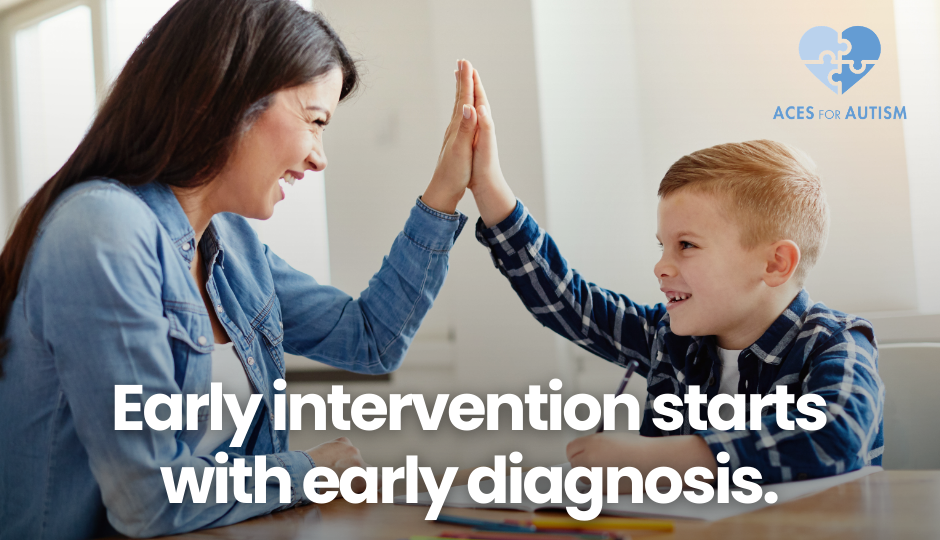
Early identification leads to early support. Research consistently shows that early intervention can improve communication skills, social development, learning, and long-term outcomes.
The earlier a child begins appropriate services, the more opportunity the brain has to build foundational skills during critical developmental windows.
Unfortunately, many families searching for autism screening or autism evaluation near them encounter long waitlists. Those months matter.
Acting early allows families to move forward with confidence instead of waiting and wondering.

Autism Screening and Diagnostic Evaluations in Eastern North Carolina
Families searching for autism screening in Eastern North Carolina often experience delays when trying to schedule a full diagnostic evaluation.
While screening is an important first step, a comprehensive autism diagnostic evaluation is what provides clarity and a formal diagnosis.
At Aces for Autism, we support families who have concerns identified through autism screening and offer expedited autism diagnostic evaluations for children five years old and younger.
Our goal is simple:
Reduce wait times. Provide clear answers. Help families access services sooner.
What Happens During a Diagnostic Evaluation at Aces for Autism?
At our Winterville clinic, children attend their evaluation with a parent or guardian in a welcoming, child-friendly environment.
The evaluation may include:
A conversation about your child’s developmental history
Structured observation through play
Age-appropriate diagnostic tools
Parent questionnaires and discussion
Our goal is clarity. We want families to leave with a better understanding of their child’s strengths, areas of need, and next steps.
We approach every evaluation with compassion, professionalism, and hope.
Is Autism Screening or Autism Testing Covered by Insurance?
Many parents wonder whether autism screening or autism testing is covered by insurance.
In most cases, autism screening performed during routine well-child visits is included as part of preventive pediatric care and is often covered by insurance. The American Academy of Pediatrics recommends screening at 18 and 24 months, and many plans include this as part of standard developmental monitoring.
A comprehensive autism diagnostic evaluation, sometimes referred to as autism testing, is typically covered when it is considered medically necessary. Coverage may depend on:
Your insurance provider
Whether the provider is in-network
Referral or prior authorization requirements
Your deductible and copay structure
Because policies vary, it is always best to contact your insurance company directly to confirm your specific benefits.
If you are unsure where to begin, your pediatrician and our team at Aces for Autism can help guide you through the next steps.
Is Autism Screening or Autism Testing Free?
Autism screening completed during a routine pediatric visit is often included in the cost of that visit.
Some community programs and early intervention agencies may also offer free developmental screening services for young children.
However, a full autism diagnostic evaluation is a more in-depth medical service and is not typically free unless provided through certain public early intervention programs or school systems.
Understanding the difference between screening and formal testing can help families plan appropriately and avoid unexpected surprises.
Frequently Asked Questions About Autism Screening
What age should a child receive autism screening?
The American Academy of Pediatrics recommends autism screening at 18 and 24 months. However, if you notice developmental concerns at any point in your child’s early years, you can request screening.
What happens if my child does not pass an autism screening?
A positive screening result does not automatically mean your child has autism. It simply means a comprehensive diagnostic evaluation is recommended to gather more information.
Is autism screening harmful or stressful for my child?
No. Autism screening typically involves parent questionnaires and observation. It is non-invasive and child-friendly.
Why is early diagnosis important?
Early diagnosis allows children to begin early intervention services during critical stages of brain development, improving communication, social skills, and adaptive functioning.

You Are Not Alone
If you are searching for autism screening, it likely means you care deeply about your child’s growth and future.
At Aces for Autism, we believe every child is wonderfully made and filled with God-given potential. Early understanding allows us to nurture that potential with care, compassion, and purpose.
If you are looking for autism screening or an expedited autism diagnostic evaluation in Eastern North Carolina, our team is here to help.
Early answers lead to early support. And you do not have to walk this journey alone.
Contact our team: (252) 689-6645